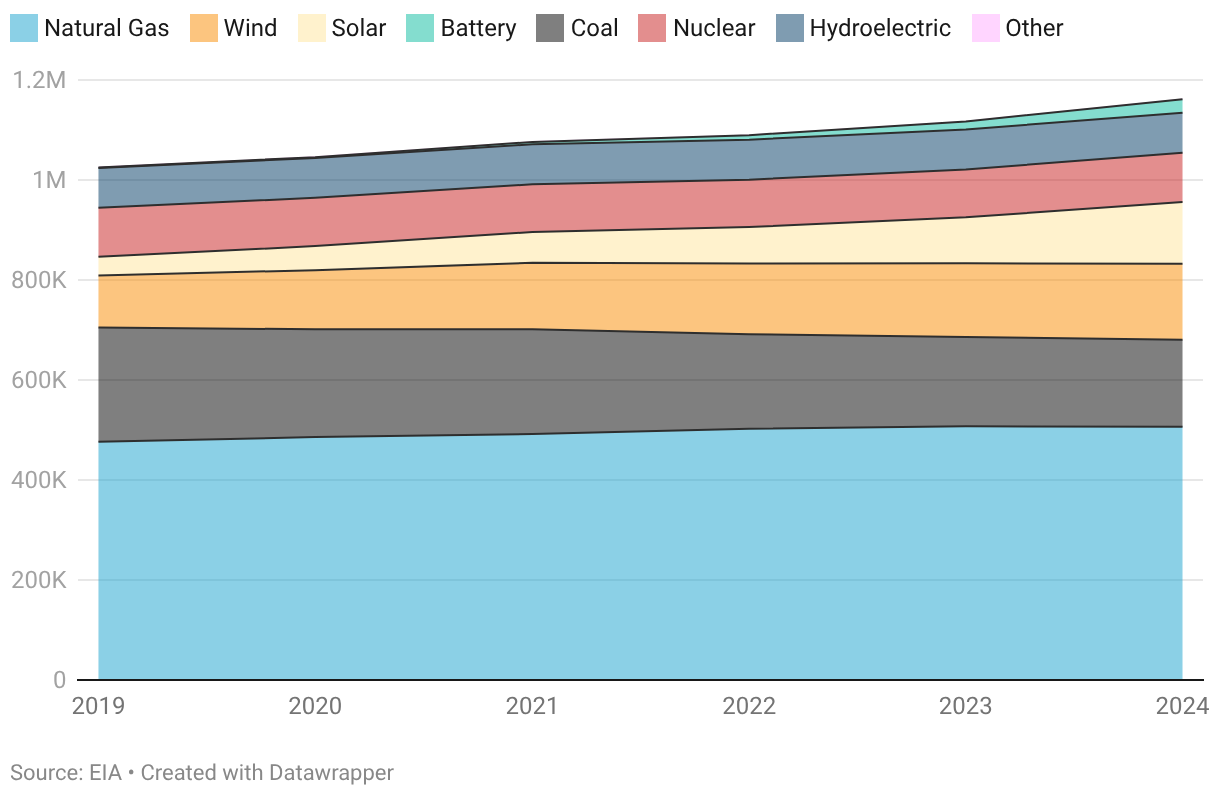
Total US Generation Capacity (MWh) by Generation Source
This dataset reports total U.S. electricity generation capacity by energy source, including natural gas, coal, nuclear, wind, solar, hydroelectric, battery storage, and other sources. Capacity values are aggregated at the national level and presented by calendar year from 2019 through 2024, representing the maximum installed nameplate capacity available to generate electricity in each year. All values are expressed in megawatt-hours (MWh).
Last updated: 2024
How to Read This Chart
This stacked area chart shows total U.S. electricity generation capacity by energy source from 2019 through 2024, measured in megawatt-hours (MWh). Each colored band represents a different generation source, including Natural Gas, Coal, Nuclear, Wind, Solar, Hydroelectric, Battery storage, and Other sources. The horizontal axis shows the calendar year, while the vertical axis shows the total installed generation capacity. The thickness of each band reflects how much capacity each source contributes in a given year, and the full height of the stack represents total U.S. generation capacity. Changes in the size of individual bands over time indicate growth or decline in capacity for each source.
Why This Matters
Generation capacity determines how much electricity the U.S. power system is capable of producing, even if that capacity is not used at all times. The data shows continued growth in total capacity, driven primarily by natural gas and rapid expansion of solar, wind, and battery storage, while coal capacity steadily declines. Tracking capacity by source helps explain structural shifts in the U.S. energy mix, informs grid reliability planning, and provides context for policy decisions related to decarbonization, fuel diversity, and infrastructure investment. For utilities, regulators, and market participants, this data highlights how the power system is evolving to meet demand growth while integrating more variable and storage-backed generation resources.
Key Insights
The following highlights are derived directly from the most recent available data in this dataset using standardized calculations. Metrics reflect aggregate U.S. electricity generation capacity across all reported sources and are computed from the underlying time series. Unless otherwise noted, comparisons are based on the most recent complete reporting year and prior comparable periods. These highlights provide a concise snapshot of changes in U.S. generation capacity by source.
Total U.S. generation capacity in 2024: approximately 1.16 million MWh, an increase of 3.5% year-over-year compared with 2023.
Generation capacity mix in 2024: Natural gas accounted for 43.6% of total capacity, followed by Coal (15.0%), Wind (13.1%), Solar (10.6%), and Nuclear (8.5%).
Largest year-over-year capacity change (2024 vs. 2023): Solar capacity increased by approximately 31.4 thousand MWh, the largest absolute change among all reported sources.
Definitions
| Term | Description |
|---|---|
| Generation capacity | The maximum electrical output that generating units are capable of producing under specific conditions, measured as installed nameplate capacity and expressed here in megawatt-hours (MWh). |
| Energy source | The primary fuel or technology used to generate electricity, such as natural gas, coal, nuclear, wind, solar, hydroelectric, battery storage, or other sources. |
| Battery storage | Grid-connected battery systems capable of storing and discharging electricity; reported capacity reflects power output capability aggregated annually. |