Gatby 2025 Enrollments: Trends, Pricing by Month, and Term Insights
Explore Gatby 2025 enrollments, term distribution, and monthly average price trends to understand how customers choose plans and timing.

Written by Hash Manesia
Published on Mar 4, 2026
|
3 min read
Reviewed by Hash Manesia, Kyle Aubuchon
:quality(80))
Gatby 2025 Enrollments: Trends, Pricing by Month, and Term Insights
Understanding Gatby 2025 enrollments helps customers, analysts, and partners see how plan length preferences and electricity pricing trends shape enrollment behavior. By analyzing enrollment distribution by term and average monthly prices, we can identify clear patterns that explain why most users choose specific plans at specific times.
This article breaks down the data visually and practically so you can quickly understand what’s happening, why it matters, and how to use these insights.
Enrollment Distribution by Contract Term in 2025
Dominance of 12-Month Enrollments
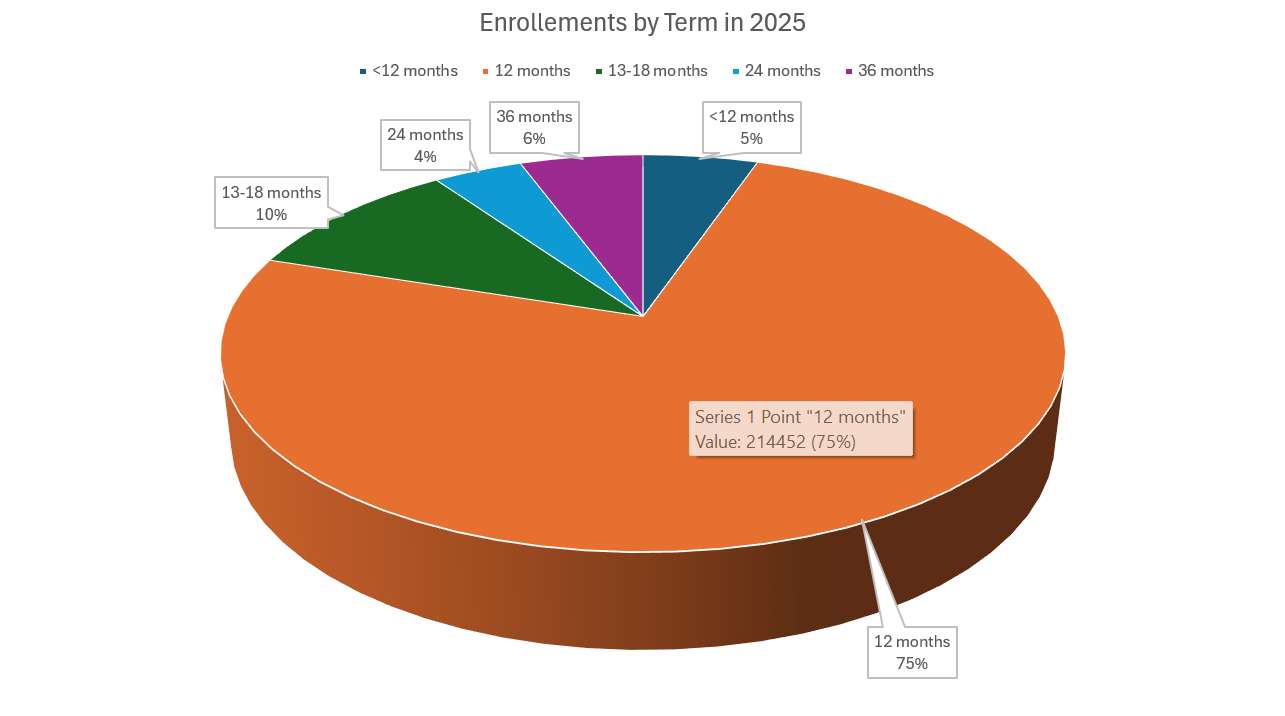
The enrollment distribution shows a strong preference for 12-month plans, which account for 75% of all enrollments in 2025. This indicates that most customers value:
- Predictable annual pricing
- Flexibility without long-term lock-in
- Alignment with common household budgeting cycles
Supporting Enrollment Segments
- 13–18 months (10%): Chosen by customers seeking moderate price stability beyond one year
- 36 months (6%): Appeals to long-term price certainty seekers
- <12 months (5%): Used for short-term needs or transitional periods
- 24 months (4%): Least popular due to limited perceived advantage versus 12 or 36 months
Key takeaway: Gatby customers overwhelmingly favor plans that balance stability and flexibility.
Average Electricity Price Trends by Month
Seasonal Price Movement in 2025
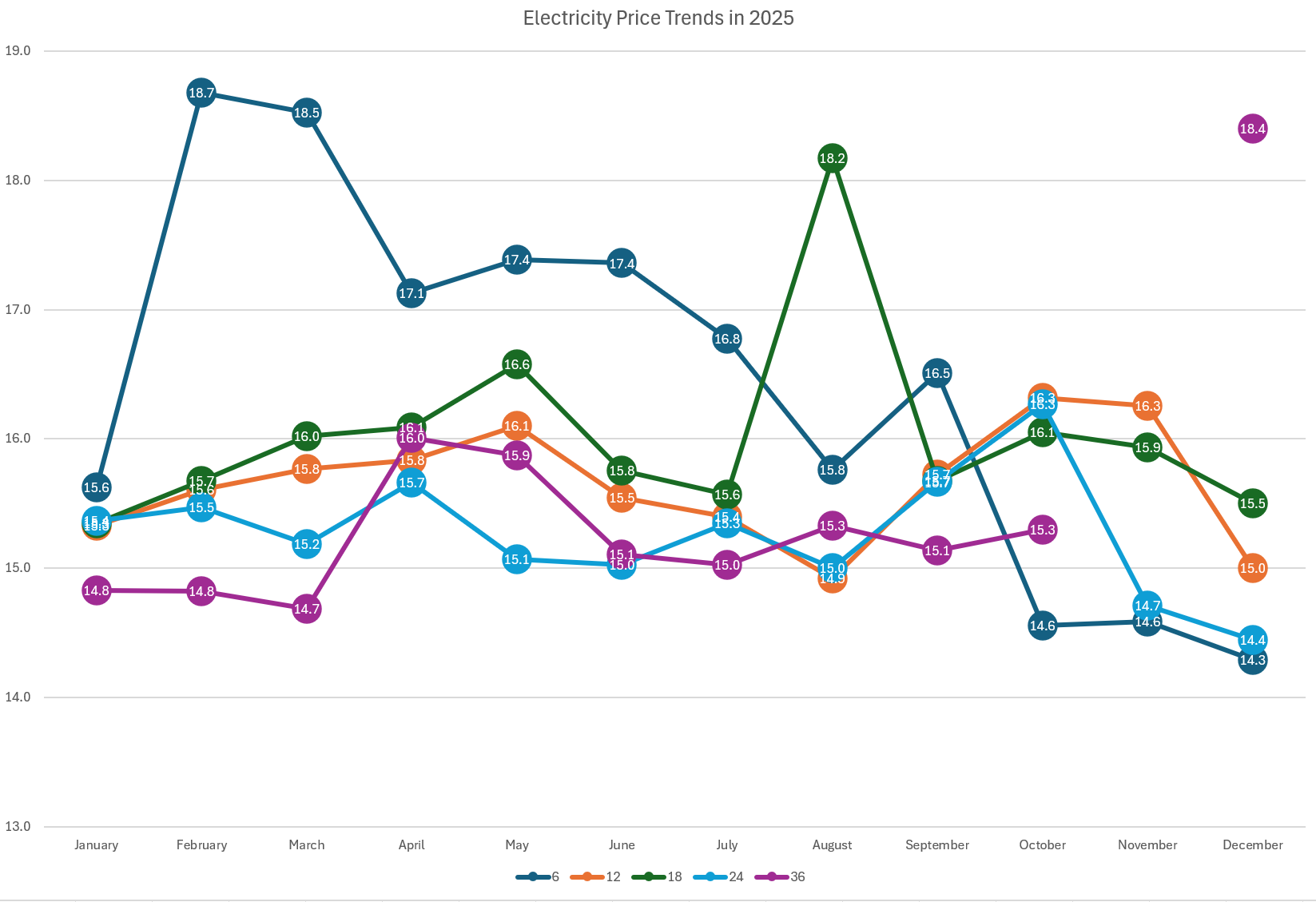
The monthly pricing chart highlights clear seasonal trends across all contract terms:
- Late winter to early spring (Feb–Mar) shows higher average prices, especially for shorter terms
- Mid-year stability (May–July) as prices normalize
- Late summer volatility (August) with noticeable spikes in longer-term plans
- Year-end decline (October–December) where several plans reach their lowest averages
Short vs Long-Term Price Behavior
- 6-month plans peak early in the year (up to ~18.7) and drop sharply by Q4
- 12-month plans remain relatively stable, reinforcing their popularity
- 18–36 month plans show smoother curves, offering insulation from short-term price swings
Why this matters: Customers enrolling during lower-price months can lock in favorable rates, especially on 12- and 18-month terms.
How Pricing Influences Enrollment Choices
Why 12-Month Plans Win
Combining both charts reveals a clear relationship:
- Stable pricing across most months
- Minimal exposure to extreme seasonal spikes
- Strong alignment with customer risk tolerance
Customers appear to optimize for predictability, even when shorter plans occasionally offer lower short-term prices.
Strategic Enrollment Timing
For customers evaluating Gatby plans in 2025:
- Best months to enroll: October–December
- Best balance of value and flexibility: 12-month term
- Best for long-term certainty: 18–36 month plans during price dips
Conclusion: What Gatby 2025 Enrollment Trends Tell Us
The Gatby 2025 enrollments data clearly shows that customers prioritize price stability, simplicity, and seasonal timing. With 12-month plans dominating enrollments and average prices softening toward year-end, the data supports a strategy of enrolling during lower-price months while choosing terms that limit volatility.
Actionable takeaway:
If you’re deciding on a Gatby plan, focus on 12-month enrollments during Q4 to capture the best balance of cost, flexibility, and predictability.
Table of Contents
Table of Contents