What Are Majority of Texas Retail Electric Provider Complaints About?
PUCT data shows billing is the number one reason Texans file complaints against Retail Electric Providers. Below we will take a deeper dive.

Written by Hash Manesia
Published on Mar 4, 2026
|
5 min read
Reviewed by Kyle Aubuchon
:quality(80))
What Are Majority of Texas Retail Electric Provider Complaints About?
Key stats (Retail Electric Provider only):
- Total Retail Electric Provider complaints in the period: 8,329
- Retail Electric Provider complaints about billing: 3,985
- Billing share of Retail Electric Provider complaints: 47.8%
- Total refund dollars from Retail Electric Provider complaints: $617,391.83
- Refund dollars tied to billing complaints: $401,140.27
- Share of Retail Electric Provider complaints that include any refund: 22.6%
- Median refund amount when there is a refund: $145
Time window of data: complaints received from January 3, 2024 through October 31, 2025.
What the PUCT billing complaint data says
Billing problems are the main event in Texas electricity complaints. In the PUCT informal complaint data, almost one out of every two complaints against Retail Electric Providers is about billing.
Out of 8,329 total Retail Electric Provider complaints in this period, 3,985 are tagged as Billing. That is 47.8% of all Retail Electric Provider complaints.
Billing is also where most of the refund dollars live. Across all Retail Electric Provider complaint types, customers receive about $617 thousand in refunds. Roughly two thirds of that money (~$401 thousand) comes from billing complaints alone.
Most complaints do not result in any refund at all. Only 22.6% of Retail Electric Provider complaints include a positive refund. For the ones that do get paid, the median refund is $145. Enough to matter on a monthly bill, but not “buy a boat” money.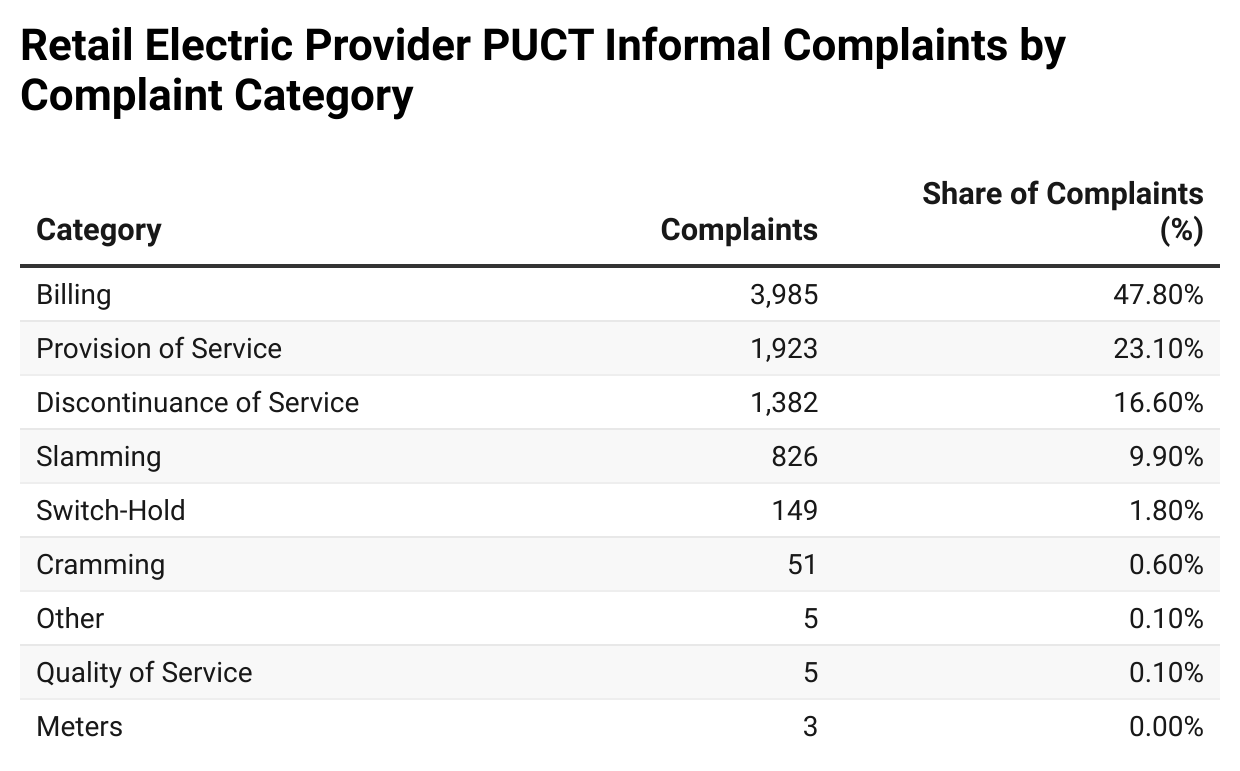
The main billing triggers we see
The complaint categories in the data point to a small set of recurring billing problems. The patterns are boring and predictable, which is good news. Boring is fixable.
Common billing triggers in the PUCT complaints:
- Unexpected price jumps: Customers roll off a promo or contract term and see a new rate, sometimes without realizing the old term expired.
- Plan mismatch: The bill does not match what the customer believes they signed up for. Different energy rate, different base charge, or the wrong product.
- Usage shocks with no explanation: Bills jump, but the customer has no context. Sometimes usage truly spikes (heat wave, extra occupants, broken equipment). Sometimes the issue is a meter read or estimate feeding into the bill.
- Fees that were not clearly explained: Late fees, minimum usage fees, or other charges that were technically in the fine print but never landed with the customer.
- Delayed or missing credits: Provider promised an adjustment or credit. It never shows, or it shows for the wrong amount, so the customer escalates.
For a lot of Texans, the bill is the only monthly touchpoint with their provider. When that one touchpoint is confusing or feels off, complaints follow.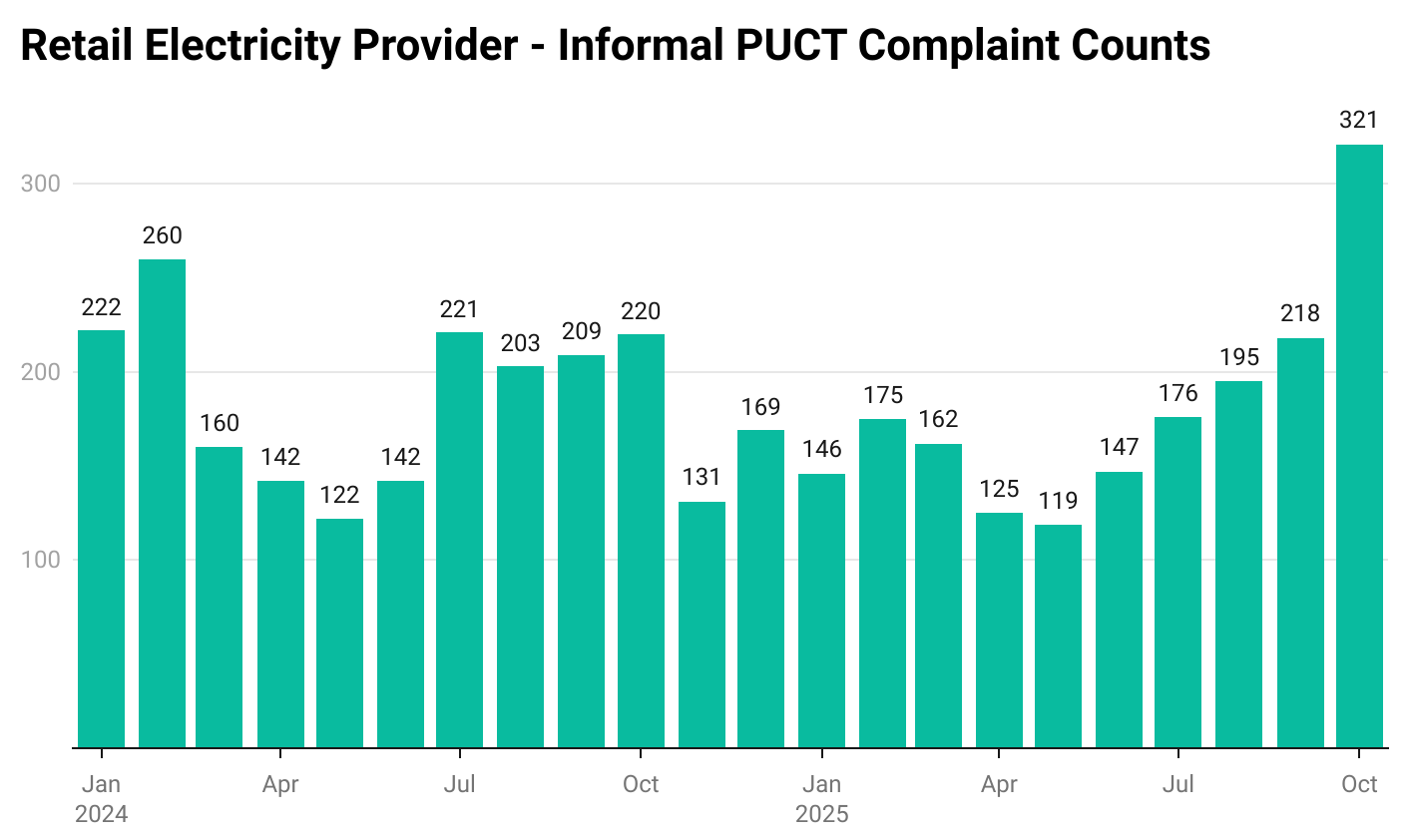
Power Moves before you escalate a billing complaint
You cannot control market prices, but you can control the evidence you bring to a billing dispute. The data say refunds cluster where the error is clear and documented.
Power Moves before you escalate:
- Compare your bill to your plan facts label. If the energy rate or base charge on the bill does not match the plan document, you have a concrete issue.
- Check usage against past periods and weather. Compare this month to last month and to the same month last year. A big jump in extreme heat might be normal. A big jump in mild weather needs a closer look.
- Confirm move-in and switch dates. Partial months and overlapping accounts can make bills look strange. Make sure service dates match reality.
- Ask the provider for a written breakdown. Calls are fine. Written explanations are better. Get line items explained by email.
- Then decide whether to file with the PUCT. Complaints close faster when you attach the plan, the bill, and the provider’s written response. The goal is to prove a specific billing error, not to rant.
How this helps Texans avoid billing trouble
The complaint numbers are a warning label for the whole market. If nearly half of Retail Electric Provider complaints are about billing, better billing transparency is the cleanest way to reduce headaches for everyone.
For customers, that means:
- Choosing plans with clear pricing instead of teaser offers with cliffs.
- Tracking plan end dates so price changes do not feel like ambushes.
- Keeping contracts and emails in one place, so disputes are evidence-backed, not emotional.
For providers, it is a signal that investing in transparent billing and clearer communication matters more than another short-term promotion.
Gatby’s job is to make the trade-off obvious. We surface the real price, highlight the fine print that drives complaints, and help renters pick plans that are less likely to show up in this dataset later.
FAQ
Q: How often do billing complaints get refunds?
- Refunds are not automatic. About 22.6% of Retail Electric Provider complaints of any type include a positive refund. Billing complaints drive most refund dollars, but outcomes depend on documentation and a clear mismatch.
Q: How long do complaints take to resolve?
- Most close in weeks, not months. Exact timing depends on response speed and evidence quality.
Q: What should I attach to a billing complaint?
- Your plan facts label, bill PDFs, and any written responses from your provider. The clearer the math, the smoother the resolution.
Think your bill is off? Gatby helps you compare today’s rate to what you should be paying in your building and city. Power to the people.
Table of Contents
Table of Contents