How to Read a Texas Electricity Facts Label (EFL) 2026–2027 Consumer Guide
Learn how to read a Texas Electricity Facts Label (EFL) for 2026 and 2027. Understand PUC rules, average price columns, and hidden charges—then compare verified plans on Gatby.



Last Updated: Wednesday, March 4th, 2026
Compare rates from the top 25+ electricity providers
What Is a Texas Electricity Facts Label (EFL)?
An Electricity Facts Label (EFL) is the standardized disclosure document every Retail Electric Provider (REP) in Texas must publish for each plan. It lists the plan's pricing, fees, contract length, and renewable content—just like a nutrition label for your power bill.
Created under PUC Substantive Rule §25.475, the EFL exists so Texans can see exactly what they pay per kilowatt-hour (kWh) before signing a contract.
Power Move: The EFL is your truth document—everything else is marketing. Always read it before enrolling.
Main Takeaways
The EFL is a standardized document required by Texas law that shows the true cost of every electricity plan.
Always compare plans using your actual usage (not the sample 500/1,000/2,000 kWh).
The advertised rate is often lower than your real rate due to base fees and TDU charges.
Look beyond the headline price—check for early termination fees, bill credits, and minimum usage requirements.
Gatby automatically parses EFLs to show you the real cost at your usage level.
Why the EFL Exists (and Why It Matters)
Before 2002 deregulation, Texans had no choice of providers. Now, competition means hundreds of plans —and lots of confusion. The EFL standardizes disclosure to prevent "bait rates."
- PUC Rule §25.475 requires every REP to show clear pricing, fees, and contract terms.
- PUC Rule §25.476 defines green-energy labeling and marketing accuracy.
These rules protect you by making deceptive pricing unlawful and forcing providers to show how they calculate your rate.
Where to Find the EFL Before You Enroll
You'll find a plan's EFL:
- On the provider's website
- On the state's comparison portal PowerToChoose.org
- Within Gatby's marketplace , where EFLs are linked directly beside each rate
Never sign up based on an ad or 'average rate' alone. Always open the PDF or HTML EFL and read the details.
How to Read Each Section of the EFL
Each EFL follows a consistent format set by the PUC. Here's what to look for:
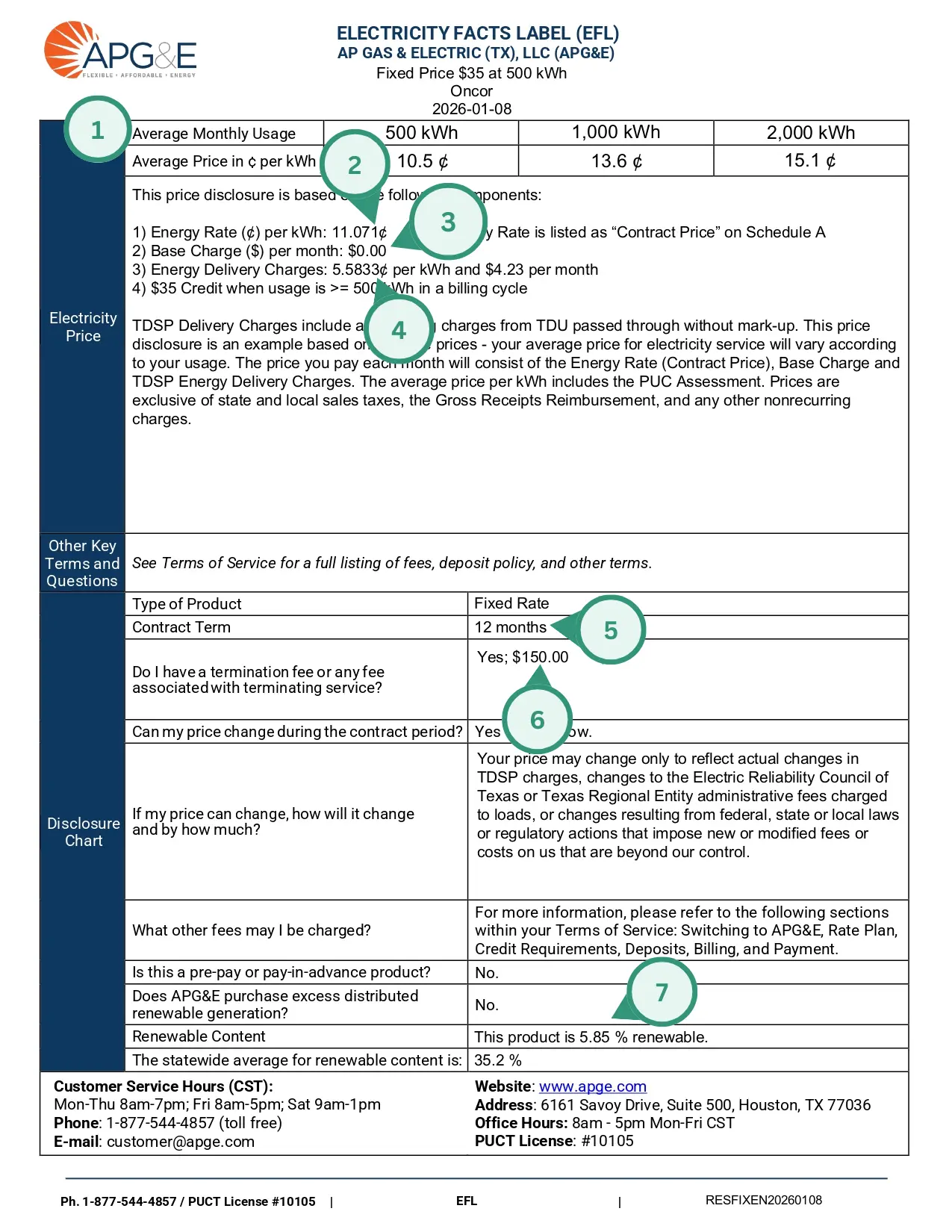
1. Average Price per kWh
Shows estimated cost at three usage levels (500, 1,000, and 2,000 kWh).
- Apartments: Use the 500 kWh column.
- Single-family homes: Use 1,000–2,000 kWh.
The average price includes energy charge + delivery fees + base fees divided by usage.
2. Energy Charge
The cost per kWh for the electricity itself. Usually between 8¢ and 15¢/kWh for fixed-rate plans in 2026.
3. Base Charge or Minimum Usage Fee
A flat monthly fee (e.g., $4.95) or a penalty if you don't use enough electricity.
4. TDU Delivery Charges
Pass-through fees from your Transmission and Distribution Utility (TDSP). These vary by region— CenterPoint (Houston) and Oncor (Dallas) being the largest.
5. Contract Term
The length of your agreement (usually 6–36 months). Shown as "Term of Service" on the EFL.
6. Early Termination Fee (ETF)
The fee charged if you leave the plan early. Often $150–$200 flat or $20 per remaining month.
7. Renewable Content
Shows the percentage of electricity generated from renewables. If it's "100%," that plan purchases Renewable Energy Credits (RECs).
How to Calculate Your Real Rate Using the EFL
To find your true rate (not the "average"), plug your usage into this formula:
Real Rate = [(kWh × Energy Charge) + Base Fee + TDU Fees] ÷ kWh
Example 1: Apartment (650 kWh)
(650 × $0.14 + $4.95 + $30 TDU) ÷ 650 = 19.38¢/kWh
Example 2: Home (1,200 kWh)
(1,200 × $0.13 + $4.95 + $45 TDU) ÷ 1,200 = 17.16¢/kWh
Your real rate is almost always higher than the advertised average—use your own usage, not their sample.
Plan Types You'll See on an EFL
| Plan Type | Description |
|---|---|
| Fixed Rate | Locked-in rate for the contract term. Predictable and stable monthly bills. |
| Variable Rate | Rate changes monthly based on market conditions. Riskier but flexible. |
| Time-of-Use (TOU) | Rates differ by time of day. Lower overnight, higher afternoons. Requires a smart meter. |
| Bill Credit / Usage Credit | Credits applied when you hit specific usage thresholds. Great if you meet the target consistently. |
| Green / Renewable Plans | Powered by renewable credits. May cost slightly more but support clean energy. |
Spotting Gimmicks and Fine Print
Promos like "free nights and weekends" often charge higher base rates to offset the free hours. Watch for usage thresholds ("discount kicks in after 1,000 kWh"). Those numbers are buried in the EFL's footnotes.
If a plan advertises 'free', scroll to the EFL's pricing table and do the math. Free usually isn't.
Common Mistakes Texans Make When Reading EFLs
- Ignoring their actual usage. Using 1,000 kWh when they consume 650.
- Not factoring TDU fees. That's 30–40% of the bill.
- Assuming renewable = solar power. It's often RECs from wind or grid credits.
- Skipping the ETF section. ETFs apply even for moves unless you prove address change.
- Comparing only headline rates. Always compare total cost at your usage level.
How Gatby Uses the EFL to Protect Consumers
Every plan on Gatby's marketplace is audited against its official EFL before it appears online.
- Gatby shows true all-in pricing, including TDU charges.
- Deceptive plans are flagged or removed.
- Users see rates tailored to their usage patterns (apartment vs. home).
Glossary: EFL Terms Every Texan Should Know
| Term | Description |
|---|---|
| Average Price per kWh | The total cost (energy + delivery) divided by total usage. Often misleading when comparing plans. |
| Base Charge | Flat monthly fee added to every bill. |
| CenterPoint Energy | The TDSP serving Houston and surrounding areas. |
| Delivery Charges (TDSP Fees) | Fees set by your utility for maintaining poles, wires, and meters. |
| Electricity Facts Label (EFL): | A standardized document showing plan rates, terms, and fees. |
| Fixed-Rate Plan: | Your price per kWh stays constant through the contract term. |
| Green Energy Plan: | Uses renewable energy credits (RECs) to match 100% of usage with renewables. |
| Hidden Fees: | Undisclosed charges in some electricity plans, often buried in the fine print. |
| Indexed Rate Plan: | (Now mostly banned in Texas) ties your rate directly to wholesale market prices. |
| Kilowatt-hour (kWh): | The standard unit for electricity usage. |
| Market Rate: | The wholesale price of electricity on ERCOT's market. |
| PUCT: | Public Utility Commission of Texas — the state regulator overseeing electricity. |
| Renewable Energy Credit (REC): | Certificate proving 1 MWh of renewable generation. |
| Smart Meter: | A digital meter that tracks energy usage in 15-minute intervals. |
| TDSP (Transmission and Distribution Service Provider): | The utility company that owns and maintains power lines, poles, and meters in your area. |
| Variable Rate Plan: | Rate changes month to month based on market conditions. |
Compare Real EFLs with Gatby
Before you enroll, read the label that tells the truth. Gatby decodes every EFL for clarity and shows the real cost of your power—no guesswork, no surprises.
Always free. No gimmicks.